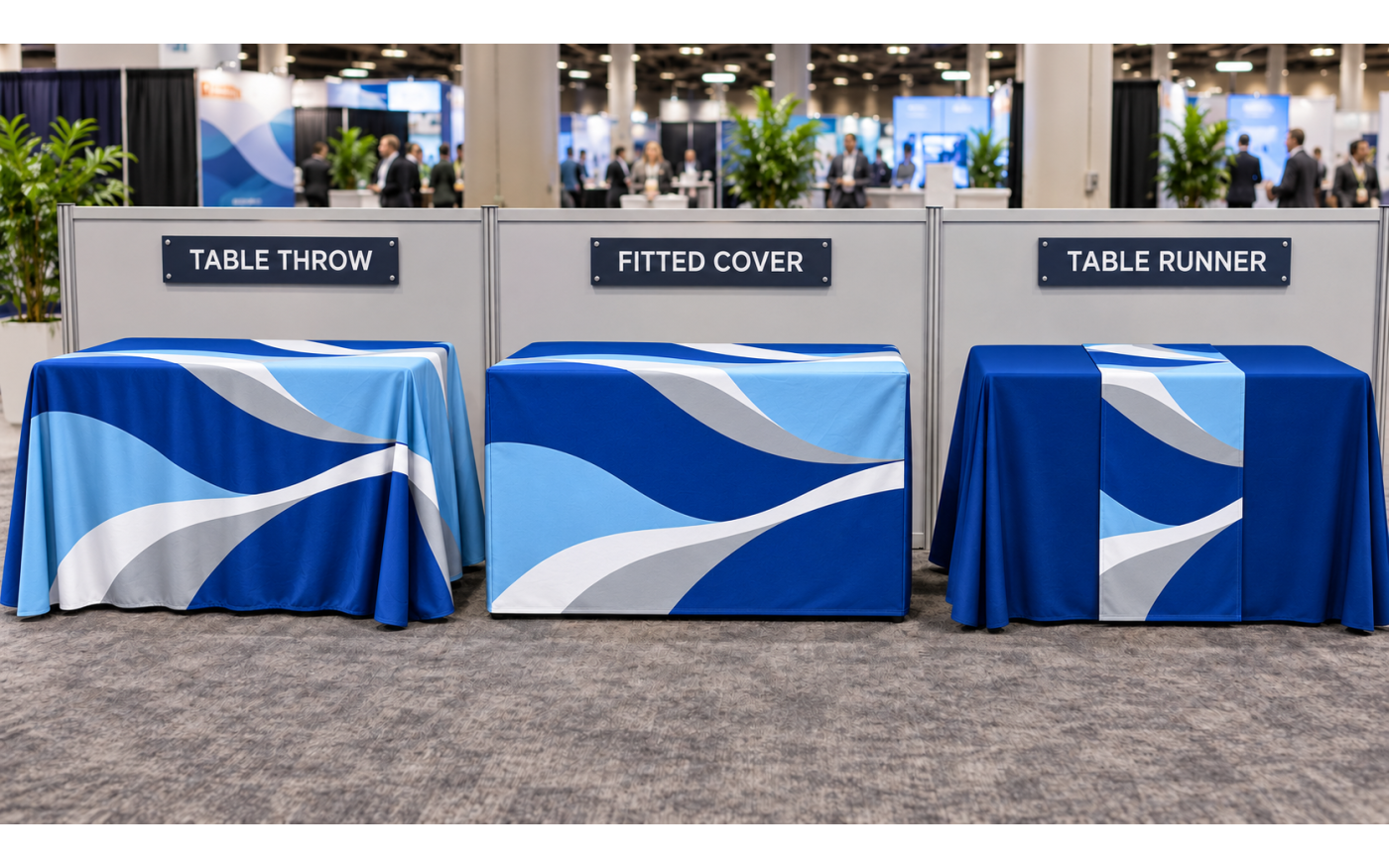
Choose a table throw when you want a flexible, traditional drape. Choose a fitted cover when the table dimensions are fixed and you need clean corners. Choose a table runner when you already have a suitable tablecloth and only need an additional area for printed branding.
The right option depends on the table dimensions, viewing direction, staff access, storage needs, and the appearance required for the event. A cover that works well at a staffed registration desk may not suit a display that visitors can approach from all four sides.
A common mistake is choosing by appearance alone. Even an attractive cover can create problems if it does not fit the table, blocks access to stored supplies, or places important artwork across a seam. This guide compares the three styles and explains what trade buyers should confirm before sending an order into production.
Key Differences in Fit and Coverage
Table throws, fitted covers, and runners all turn plain event tables into branded display surfaces. The main difference is how much of the table they cover and how closely the fabric follows its shape.
| Style | Fit | Coverage | Best Use | Main Consideration |
|---|---|---|---|---|
| Table throw | Loose, natural drape | Partial or full, depending on the product | Flexible event setups and a traditional appearance | May show creases after shipping |
| Fitted cover | Sewn corners that follow the table | Front, sides, and optional back | Known table dimensions and a defined shape | Accurate measurements are essential |
| Table runner | Narrow printed panel over another cloth | Limited branding area | Adding a logo or message to an existing tablecloth | Does not cover the entire table |
Throws provide the most forgiving drape, fitted covers require more precise measurements, and runners add a smaller branding area over an existing cloth. Coverage also determines whether stored materials remain hidden and whether staff can access the back of the table.
Which Style Fits Your Project
The right style should support how employees and visitors will use the table. Start with the event setup and functional requirements rather than selecting a product from appearance alone.
Table Throws for Flexible Event Setups
A table throw is a practical choice for trade shows, conferences, recruitment fairs, registration areas, and promotional events where a traditional draped presentation is preferred.
Its loose construction provides more flexibility than a fitted cover. Small differences in table shape or leg position are less likely to affect the overall appearance. However, a throw still needs to match the table’s length, width, and height. It should not be treated as a universal cover for every table size.
A full-coverage throw can also conceal boxes, product samples, literature, and employee belongings stored beneath the table. Economy and full table covers use different coverage layouts, so buyers should confirm which sides need to remain covered before preparing the artwork.
Businesses using standard event tables can compare a 6 ft economy table cover with a full-cover option. A throw that is too short may expose the table legs, while excess fabric may collect on the floor.
Throws can develop creases during shipping or storage. Unpack the product before the event and follow the fabric care instructions rather than opening it for the first time during booth setup.
Fitted Covers for Fixed Table Sizes
A fitted cover is suited to projects where the exact table dimensions are known. Sewn corners follow the rectangular shape of the table and create a clean, defined outline.
This style works well for corporate booths, registration desks, consultation tables, product displays, and other settings where a consistent appearance matters. The fitted construction also reduces the amount of loose fabric around the table legs.
The main limitation is sizing. Length alone is not enough. The table width and height must also match the product specifications. Even a small difference can make the cover hang unevenly or stop short of the floor.
A 6 ft fitted table cover may suit a standard event table when all three dimensions match. If employees need to sit behind the table or retrieve supplies, an open-back fitted cover may be more practical. Full-back coverage is more appropriate when visitors can see the table from several directions.
Artwork placement also requires care. Keep logos, QR codes, phone numbers, and other important information away from seams, corners, and areas where the fabric changes direction. Always prepare the artwork using the template for the selected product.
Table Runners for Existing Tablecloths
A table runner is a narrow printed panel placed over an existing tablecloth. It is useful when the venue provides a plain cover or when a business needs to add a temporary campaign message to a reusable base cloth.
Runners can support sponsor recognition, seasonal offers, event themes, department names, or client-specific branding. Print resellers may also use the same neutral base cover with different runners for several customer projects.
Because the runner does not cover the whole table, the underlying cloth remains visible. Its color and condition should coordinate with the printed design. A clean black, white, or neutral cloth usually provides a simple background for branded artwork.
Runner width determines the available branding area and how much of the base cloth remains visible. A narrow runner may hold a logo, while a wider version provides more space for a message or graphic. Measure the required tabletop coverage and front drop before preparing the file.
Custom printed table runners are not a replacement for a full cover when the entire table or storage area needs to be concealed. In that situation, a throw or fitted cover is more appropriate.
What to Confirm Before Production
Selecting the correct style is only the first step. Measurements, coverage, artwork, quantity, and timing must be confirmed before production begins.
Measure the Table Dimensions
Measure the actual table whenever possible. Record the length, width, and height instead of relying only on labels such as “6 ft table” or “8 ft table.”
Two tables with the same advertised length may have different widths or heights. These differences matter most for fitted covers because the fabric is cut and sewn to create a specific shape.
Also confirm whether the table is rectangular or round and whether it uses a standard, counter, or bar height. A cover intended for a standard folding table will not fit a taller demonstration table in the same way.
If the venue supplies the table, request its specifications from the event organizer or rental company before placing the print order.
Choose Open or Full Back Coverage
Back coverage should match the table position and the way employees will use it.
An open back is practical when staff members sit behind the table, operate a laptop, distribute materials, or frequently retrieve supplies. It keeps the working side accessible while maintaining a finished appearance across the front and sides.
Full coverage is more appropriate when visitors can approach the table from several directions. It can also conceal stored items when the back of the table remains visible.
A table against a backwall has different coverage needs from one placed in the center of an open event space. Confirm the booth layout before choosing the product.
Prepare Print-Ready Artwork
Customers must provide professional, print-ready artwork using the correct product template. The customer, print reseller, agency, or its designer is responsible for creating and checking the design before submission.
Confirm the required file format, dimensions, bleed, safe area, color settings, and image resolution. Keep important content away from seams, edges, and areas that may curve around the table.
Artwork should be prepared for the selected product rather than copied directly from another cover style. A design created for a full table throw may not align correctly on a fitted cover or runner because the panels and visible areas are different.
Review spelling, contact details, logo placement, QR codes, and image quality before approving production. A production proof can help confirm placement and job details, but it does not replace professional design or copy review.
Confirm the Quantity and Deadline
Confirm how many covers are required and whether every piece uses the same artwork. Orders for multiple locations, sponsors, employees, or clients may require separate files even when the product dimensions are identical.
Plan backward from the event date. Allow time for artwork preparation, internal approval, file review, proof approval, production, shipping, and inspection after delivery.
If several events are scheduled, consider whether one reusable design will work for all of them or whether separate runners would make campaign changes easier. Realistic quantities can reduce unused inventory when branding, contact details, or event messages may change.
Most ordering problems come from using remembered table dimensions, choosing the wrong back coverage, or applying artwork from one cover style to another product template. Confirm these details before submitting the order.
Wholesale Table Covers and Runners From 777Sign
777Sign manufactures custom table coverings for registered trade customers, including print shops, sign companies, agencies, resellers, and other businesses sourcing printed display products.
The collection includes economy table covers in 4 ft, 6 ft, and 8 ft sizes; full table covers in 4 ft, 6 ft, and 8 ft sizes; fitted and open-back fitted covers in 6 ft and 8 ft sizes; custom table runners; and round table cover options.
Trade buyers can explore wholesale custom printed table covers to compare available sizes, coverage styles, and product options for client and event projects.
777Sign focuses on printing and production rather than creative design. Customers must download the appropriate template and provide professional, print-ready artwork. Review all measurements, text, logos, colors, and graphic placement before submitting the files.
Ready to order? Register for a 777Sign trade account to view trade pricing and available product options.
Final Thoughts
Table throws offer a flexible draped presentation, fitted covers create a defined shape for known table dimensions, and runners add branding over an existing tablecloth. Choose the style based on table size, required coverage, staff access, viewing directions, and the available branding area.
Before ordering, confirm the measurements, download the correct template, and have a professional designer prepare the print-ready artwork. The best option is the one that fits correctly, supports the way staff will use the table, and can be reused across the planned event schedule.
Frequently Asked Questions
Does a Custom Table Cover Include the Table?
No. A custom table cover order normally includes the printed fabric product, not the physical table. Confirm the selected product’s contents before ordering.
Do Trade Show Table Covers Need to Be Flame Resistant?
Requirements vary by event and venue. Review the exhibitor manual and ask the organizer whether flame-resistant fabric or supporting documentation is required.
How Should Printed Table Covers Be Cleaned and Stored?
Follow the instructions for the selected product. Applicable 777Sign polyester table covers can be washed in cold water and should not be machine dried. Make sure the fabric is completely dry before folding or storing it away from moisture, direct sunlight, and sharp objects.
Can Printed Table Covers Be Used Outdoors?
Some table covers may be suitable for short-term outdoor events, but fabric, weather, and securing requirements vary. Confirm the product specifications and do not leave the cover exposed to strong wind, rain, or severe weather.